
Every advertiser hits the same wall eventually. You find something that works, a campaign that’s generating purchases at a cost you can live with, and the natural instinct is to pour more money into it. So you do. And then performance falls apart.
Cost per purchase climbs. ROAS drops. You pull back the budget and things partially recover. You’re stuck in this loop of trying to grow and watching the numbers resist every time you push.
This isn’t bad luck. It’s a predictable pattern that comes from the wrong way to scale Facebook ads. It’s also the final step in the complete guide to running Meta ads from setup to scale, and the most rewarding one once you understand it.
Why attempts to scale Facebook ads break things
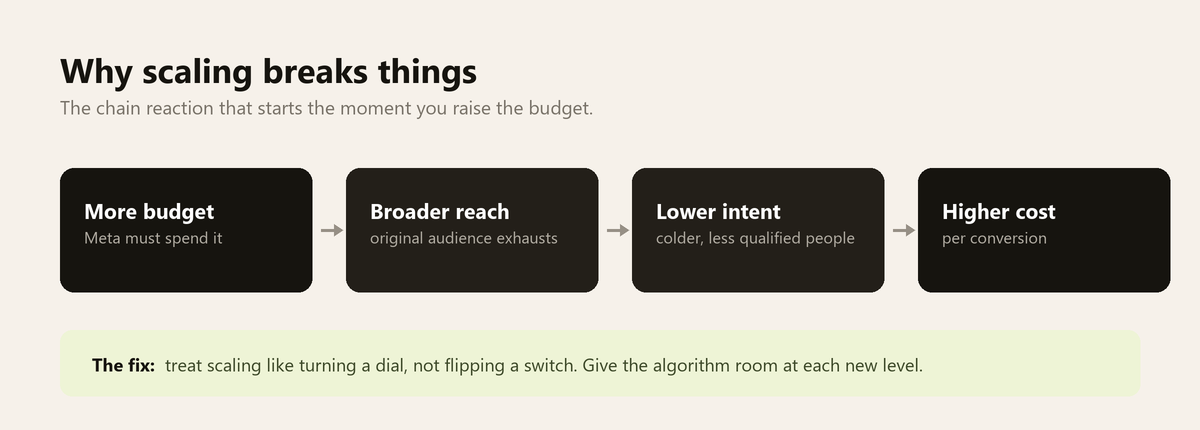
When you increase a campaign’s daily budget significantly Meta has to find new people to show your ads to. Your original audience, the people who were converting well, gets exhausted faster. The algorithm has to reach further into colder, less qualified segments to spend the budget you’ve given it.
That’s the core tension in scaling. More budget means broader reach. Broader reach means lower average purchase intent. Lower purchase intent means higher cost per conversion.
This doesn’t mean scaling is impossible. It means you have to give the algorithm time and room to adjust at each new level. The mistake most people make is treating scaling like flipping a switch when it’s more like turning a dial slowly.
The two types of scaling
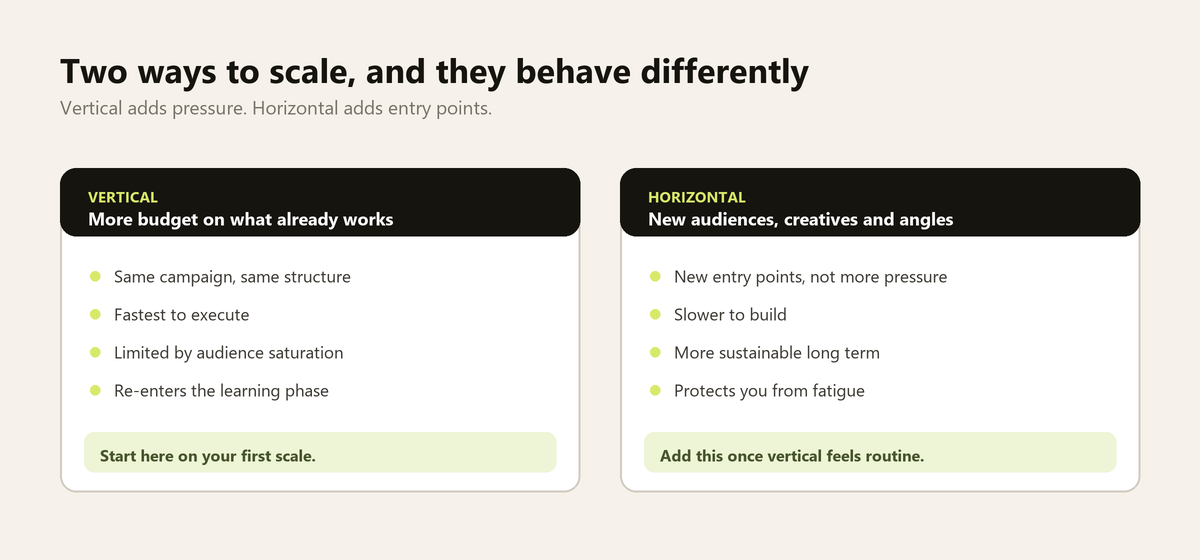
There are two main approaches and they work differently.
Vertical scaling means increasing the budget on campaigns that are already working. Same campaign, same structure, more money. This is the most common approach and it works but it has limits and requires patience.
Horizontal scaling means expanding reach through new audiences, new creatives, or new angles rather than just adding budget to what exists. This is more sustainable over the long run because you’re building new entry points instead of just pressuring existing ones.
New creative is where horizontal scaling usually stalls. Advertisers pile variations into one ad set, then cannot say which one earned the result. Testing one ad per ad set is slower and costs more, but it is the version that tells you what to make next.
Most mature ad accounts do both simultaneously. But if you’re scaling for the first time start with vertical and get comfortable with the mechanics before adding more variables.
How to scale vertically without resetting everything
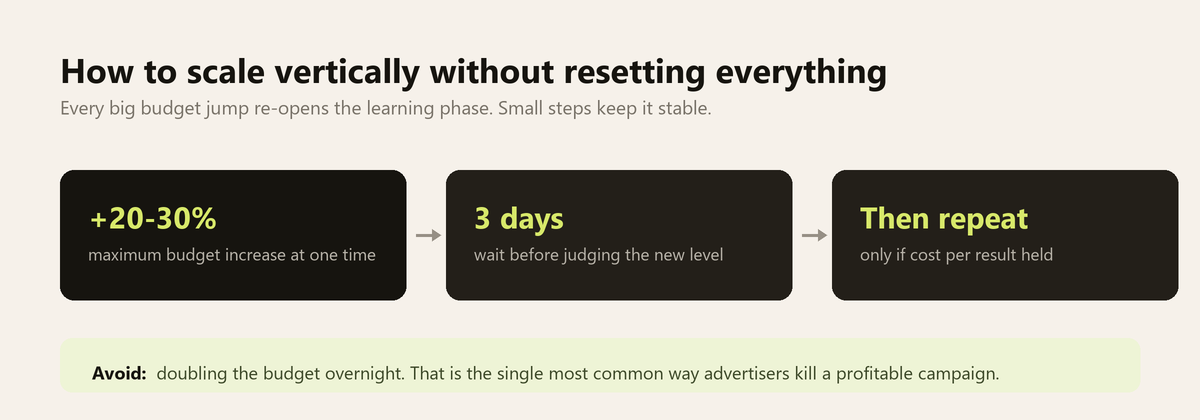
The learning phase is your main constraint here. When you make a significant budget change Meta treats the ad set as partially new and re-enters the learning phase. That instability is what causes the performance dip most people experience after scaling. The constraint here is documented by Meta: a significant budget change sends the ad set back into the learning phase. Running Advantage+ campaign budget at the campaign level reduces how often you have to touch individual ad sets at all.
The guideline that holds up in practice is this: don’t increase daily budget by more than 20 to 30 percent at a time. Let the campaign stabilize for three to five days after each increase before touching it again. Watch your cost per result during that window. If it stays within an acceptable range you can increase again.
Slow? Yes. But it compounds. A campaign that scales 25 percent every week doubles its budget in roughly three weeks without a major performance disruption.
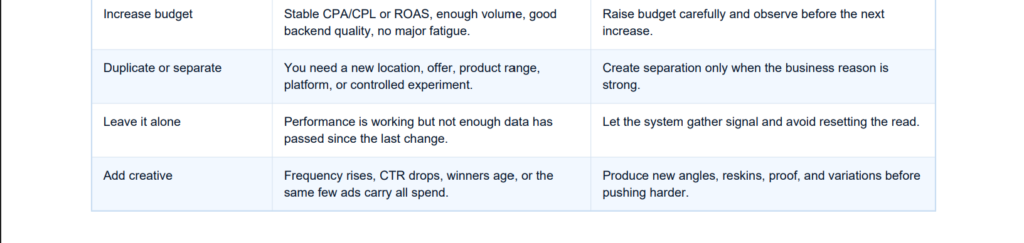
If you need to scale faster than that the safer method is duplicating the ad set rather than editing the existing one. Create a copy with the higher budget and run both simultaneously. The original keeps its learning intact. The duplicate starts fresh but you’re not betting everything on one ad set’s stability.
Horizontal scaling: finding new creative angles
At some point vertical scaling hits a ceiling. Your core audience gets saturated, people have seen your ads too many times, frequency climbs, click-through rate drops. Adding more budget doesn’t help because the problem isn’t distribution, it’s message fatigue.
This is where creative becomes your scaling lever.
New hooks, new angles, new formats. If you’ve been running static images try video. If your ads have been leading with the outcome angle try leading with pain or social proof. Each new creative approach is effectively a new audience because different people respond to different messages.
Build a testing pipeline so you always have new creative entering the account. Two or three new ads per week is a sustainable rhythm for most accounts. Some will fail quickly. Some will find a pocket of performance and become your next scaling asset.
Reading the signals that actually matter
When you’re scaling you need to watch a tighter set of metrics than usual because noise increases with budget.
ROAS and cost per purchase are your primary indicators. Set a threshold you can operate within and use that as your decision boundary not as a hope. If a campaign stays above that threshold for five consecutive days after a budget increase it’s stable.
Frequency tells you about saturation. When frequency climbs above three or four for a cold audience in a short window people are seeing your ads too often. Fresh creative or new audiences are the fix.
CPM tends to rise as you scale because you’re competing for more impressions. Some CPM increase is normal. A sudden spike often signals audience exhaustion or increased competition in your target segment.
Hook rate and hold rate for video ads tell you whether your creative is still earning attention at higher spend levels. If hook rate drops your creative needs refreshing regardless of what your ROAS looks like.
Scaling is a process not a moment
The accounts that scale well share one thing in common: they treat scaling as an ongoing operational process rather than a one-time decision. They increase budgets methodically. They refresh creative on a schedule. They watch their metrics weekly and make small calibrated adjustments instead of big reactive ones.
There’s no moment where scaling becomes automatic. But there is a point where you’ve done it enough times that you trust the process. You know what normal instability looks like after a budget increase. You know when to wait and when to act.
If you’ve worked through all five pieces, the account setup, the pixel, the campaign structure, the copy, and now scaling, you have the full system. The place most people get stuck early on is still the very beginning: understanding what Meta ads actually are versus the quick shortcuts the platform pushes you toward. Meta ads vs boosted posts is still one of the most useful places to send someone who’s just getting started.