
A few years ago I was managing an ad account that had 47 active ad sets. I’m not proud of it. That was my idea of a good Facebook ads campaign structure at the time. At the time it felt like control, different audiences, different bids, tight budget allocation across every segment. In reality it was chaos dressed up as strategy.
The algorithm was getting almost no useful data per ad set because the budget was spread so thin. Every change I made reset the learning phase. Performance was inconsistent and I spent more time managing the structure than actually improving the ads.
That approach made sense in 2018. In 2026 it actively works against you.
How Meta’s algorithm changed everything
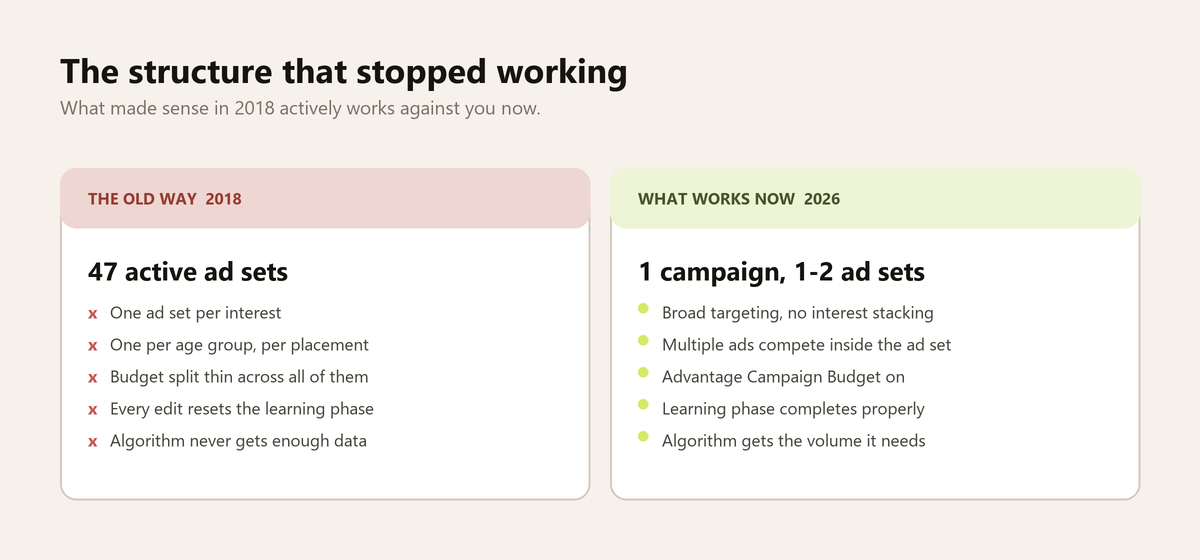
The shift happened gradually but the direction has been clear for a while. Meta’s machine learning got significantly better at finding the right people for your offer without needing you to manually slice audiences into narrow segments.
The old playbook was built on the assumption that you knew your audience better than the algorithm did. So you’d create separate ad sets for each interest, each age group, each placement. You’d control everything manually and try to outsmart the system.
The new reality is that Meta’s algorithm, when given enough budget, broad enough targeting, and enough creative to work with, consistently outperforms that kind of micromanagement. Fighting that with a fragmented structure just starves each individual ad set of the data it needs to learn.
This is one of the most important shifts covered in the step-by-step Meta ads guide for beginners, structure first, campaigns second.
The Facebook ads campaign structure that works now
If the three levels are still fuzzy, Meta explains what campaigns, ad sets and ads each control. Turning on Advantage+ campaign budget then lets the system move money between ad sets instead of you guessing.
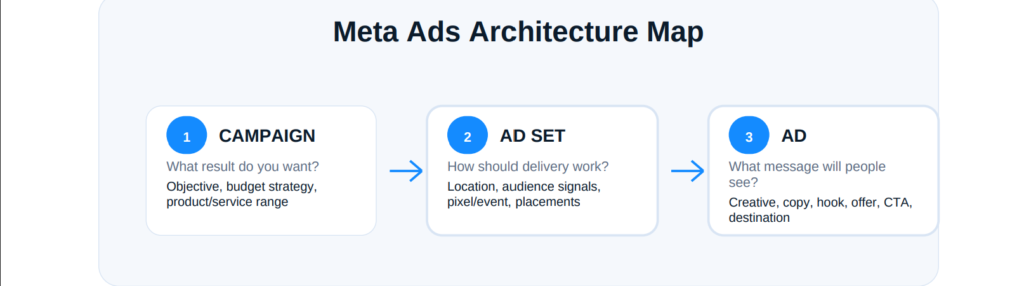
The approach that performs consistently in 2026 is simpler than most people expect. One campaign. One or two ad sets with broad targeting. Multiple ad variations inside each ad set.
That’s it. At least to start.
Campaign level, choose your objective carefully because this is the instruction you’re giving the entire system. For most businesses running direct response the right choice is “Sales” with website conversion as the conversion event. If you don’t have enough purchase data yet start with a higher-funnel event like Add to Cart or Initiate Checkout and move to Purchase once volume builds.
Advantage Campaign Budget is worth turning on here. It lets Meta distribute budget across your ad sets dynamically based on where it sees opportunity. This works better than manually splitting budget across ad sets in most cases.
Ad set level, keep it simple. One ad set with broad targeting is a legitimate starting point. Broad means minimal audience restrictions, maybe an age range if your product genuinely doesn’t apply to certain age groups, and a location. No interest stacks. No behavior layers. Let Meta find the people.
If you want a second ad set for retargeting, website visitors, people who engaged with your content, existing customer list exclusions, that’s a clean and common setup. Cold prospecting in one ad set, warm retargeting in another.
Ad level, this is where your energy should go. Three to five ad variations per ad set gives Meta enough creative diversity to find what resonates with different people. Different hooks, different formats, different angles on your offer. Just be clear about what that structure is for. It is built to perform, not to measure, because Meta decides how much each ad gets to spend.
The learning phase and why you shouldn’t touch it
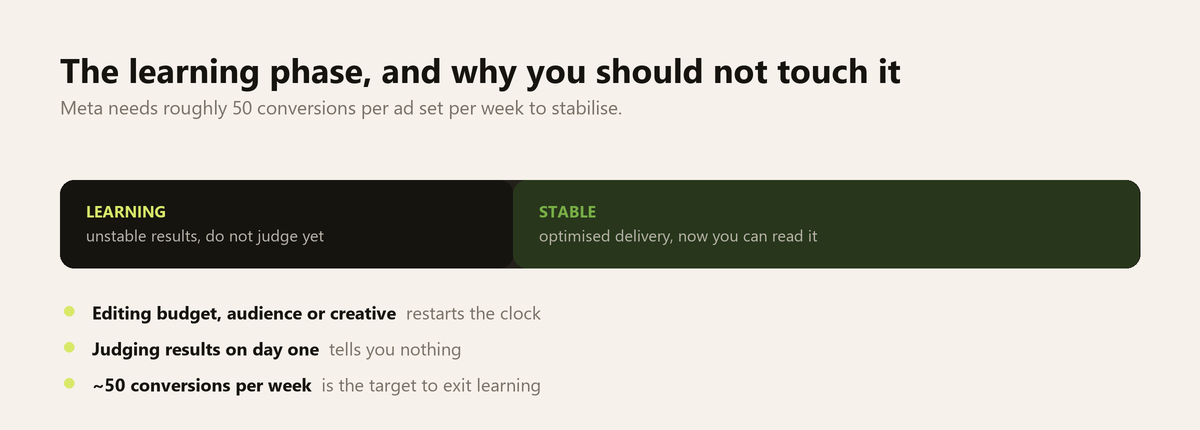
Every ad set goes through a learning phase when it launches or when you make significant changes. During this period Meta is gathering data and optimizing delivery. Performance is often unstable and cost per result can be higher than it will be once learning stabilizes. Meta documents how the learning phase works and roughly how much conversion volume an ad set needs to leave it.
The exit from learning phase requires roughly 50 optimization events in a 7-day period. This is why low budgets and fragmented ad sets are such a problem, they make it nearly impossible to exit learning phase on a reasonable timeline.
While an ad set is in learning phase resist the urge to make changes. Adjusting the budget significantly, editing the audience, swapping creative, changing the bid strategy, any of these resets the learning phase. You end up in a permanent state of instability.
What to do with underperforming ads
After a week or two of stable running you’ll have enough data to make decisions. Some ads will be generating results at an acceptable cost. Others will have low click-through rates, high costs, or minimal delivery.
Turn off the weak performers. Don’t adjust them, turn them off and replace them with new variations. Editing an existing ad resets its learning. Creating a new ad with a different approach gives you a clean read.
Keep a document of every ad you’ve tested with its results. Over time you build a picture of what angles, formats, and hooks work for your audience. That knowledge compounds.
A simpler structure means better data
The counterintuitive thing about simplifying your campaign structure is that it gives you more insight not less. When you have one ad set with five ads, Meta decides how to split the budget between them, so the ad that spends the most is not necessarily the best one. If your goal is to know which creative genuinely won, run one ad per ad set with equal budgets instead. When you have 47 ad sets with two ads each everything is noise.
Better structure means cleaner data. Cleaner data means better decisions. Better decisions mean better performance over time.
Once your Facebook ads campaign structure is solid, the next variable that matters most is what’s inside your ads. Specifically your copy, the hook, the angle, the call to action. A clean campaign structure with weak ad copy still won’t convert. How to write Facebook ad copy that stops the scroll covers exactly how to get that part right.