
I spent about six months writing ad copy that looked good to me and performed terribly in the feed. Clean design, clear offer, reasonable call to action. And people just scrolled right past it.
The problem wasn’t the product. It wasn’t the targeting or the budget. It was that I was writing for myself instead of for the person I was trying to reach. Once I understood that, everything changed. Copy sits on top of everything else, so it only pays off once the campaign structure underneath it is right.
Writing Facebook ad copy is a specific skill. It’s not copywriting in the broad sense and it’s not social media writing either. It sits somewhere in between and it has its own logic. It’s also one of the core creative principles inside the complete Meta advertising system designed for beginners and intermediates.
The feed is a brutal environment
Before getting into structure it helps to understand the context your ad lives in.
Someone is scrolling through their feed after work. They’re seeing content from friends, family, pages they follow, and your ad all competing for the same second of attention. They’re not looking for ads. They’re not in a buying mindset. They have zero obligation to stop.
You have roughly one second to earn a pause. Everything else, the body copy, the offer, the call to action only matters if you win that first second.
This is why most ad copy fails. People write the body copy first, then the headline, then throw something generic at the top. But the hook is the whole game. If it doesn’t work nothing else gets read.
What a Facebook ad copy hook actually is
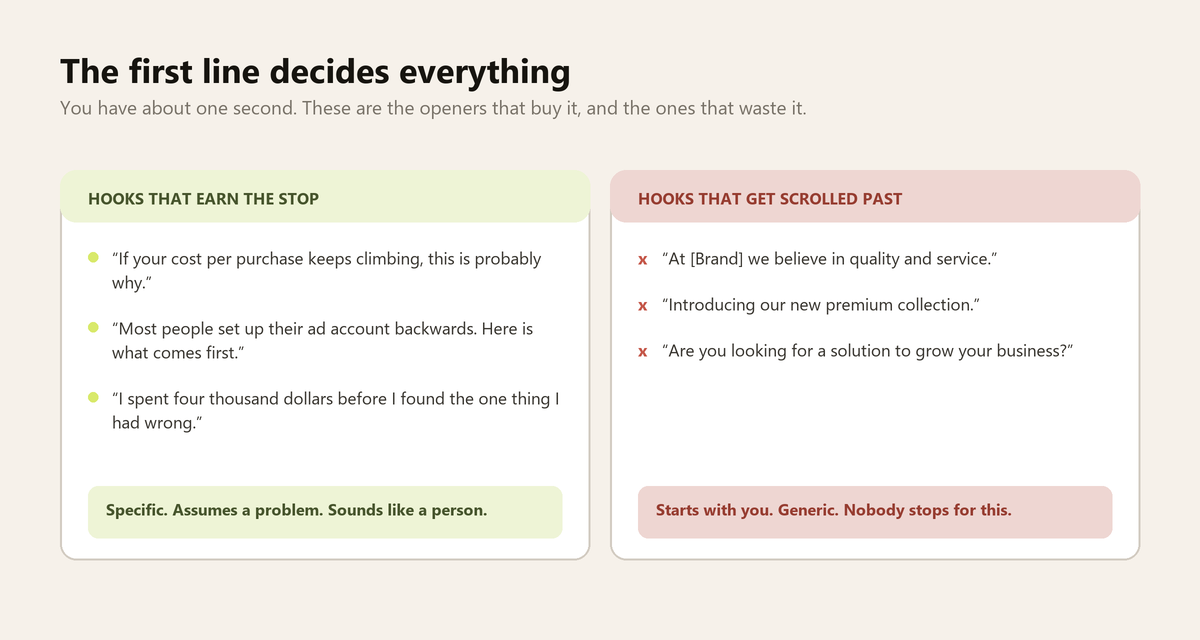
The hook is the first line of your primary text or the first frame of your video. It’s the thing that makes someone slow down.
A good hook does one of a few things. It names a specific person or situation that makes the right reader feel immediately seen. It states something surprising or counterintuitive that creates a small moment of friction. It asks a question that the reader can’t immediately answer and wants to resolve. Or it makes a bold claim that feels specific enough to be credible.
What it doesn’t do is start with your brand name, your product description, or a generic opener. Nobody stops scrolling for that.
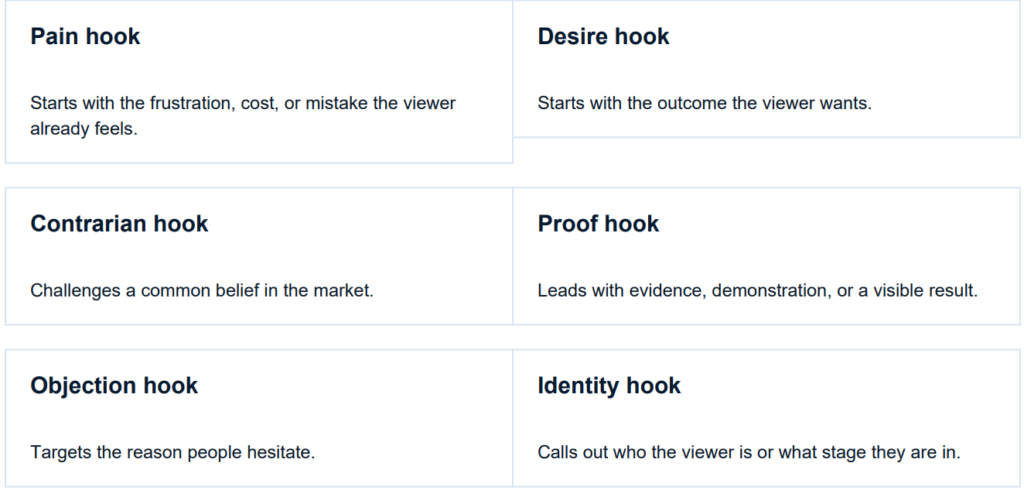
Some hooks that tend to work:
“If you’re running Meta ads and your cost per purchase keeps climbing this is probably why.”
“Most people set up their Facebook ad account backwards. Here’s what actually comes first.”
“I spent four thousand dollars on Meta ads last year before I figured out the one thing I was getting wrong.”
Notice what these have in common. They’re specific. They assume the reader has a problem or a question. They promise something useful without giving it away immediately. They feel like they were written by a person not a marketing department.
The angle underneath the hook
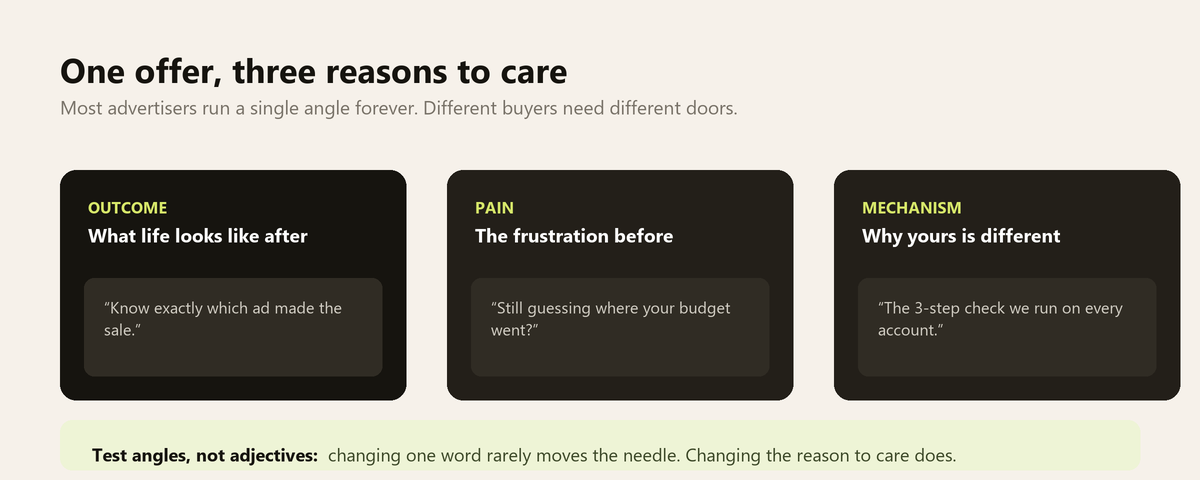
The hook gets the stop. The angle is what the ad is actually about, the specific lens through which you’re presenting your offer.
Most advertisers pick one angle and run it forever. That’s a mistake. Different people have different reasons to care about the same product. Your job is to identify those reasons and build separate ads around each one.
For a Meta ads product the angles could be:
The outcome angle : focus on what life looks like after. Lower cost per acquisition, campaigns that scale, finally understanding what the data means.
The pain angle : focus on the frustration before. Wasted budget, confusing dashboards, campaigns that worked once and then stopped.
The mechanism angle : focus on what’s different about your approach. Why this system works when other things haven’t.
The social proof angle : focus on results from real people in similar situations.
Each of these speaks to a different person at a different stage of awareness. Your angle determines who you’re talking to and how ready they are to act.
Body copy: keep the promise alive
Once someone stops and reads past the hook your body copy has one job: maintain enough interest to get them to the call to action. Keep the claims in it inside Meta advertising standards, because copy that promises a specific result is one of the more common reasons an ad gets rejected.
Good body copy usually follows a loose structure. Acknowledge the problem or situation the hook referenced. Add a specific detail or piece of insight that builds credibility. Introduce your solution in a way that connects naturally to what came before. Then lead into the call to action.
Paragraph length matters more than most people think. Short paragraphs, one or two sentences, are easier to read in a feed. A wall of text signals effort to the reader and most won’t make that effort. Use line breaks generously.
Specificity is your friend throughout. “Lower your cost per result” is weaker than “cut your cost per purchase by thirty percent in the first two weeks.” Specific claims feel more honest and more credible than vague ones.
The call to action
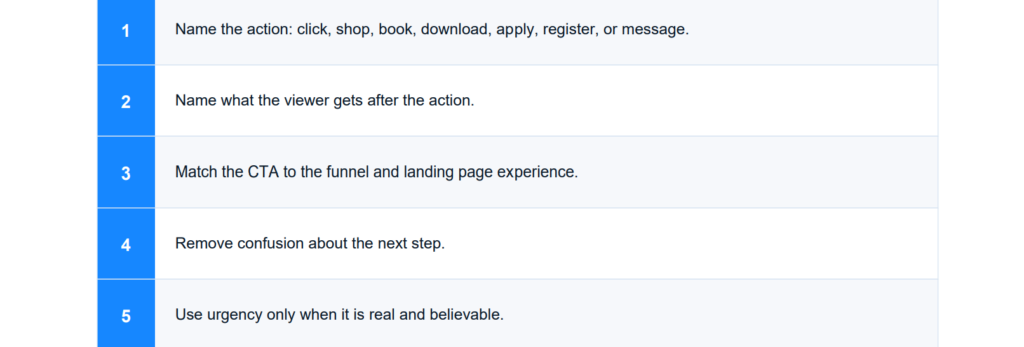
The CTA is the last line before the button. It should be direct and match the temperature of the audience.
Cold traffic needs a softer ask. “Get the free guide” or “see how it works” is less friction than “buy now.” Warm retargeting audiences who’ve already visited your product page can handle a more direct push.
The button label on your ad should match the action you’re asking for in the copy. If your copy says “grab the free checklist” and your button says “Shop Now” there’s a mismatch that creates friction. Keep them aligned.
Testing is the only way to know
The frustrating truth about ad copy is that you can’t fully predict what will work for a specific audience. What you can do is build a system for testing. Launch three to five ad variations with meaningfully different hooks. If you want a clean read on which hook won, rather than which one Meta decided to spend on, give each variation its own ad set with an equal budget. Give them a week of reasonable spend. Look at click-through rate and cost per result. Kill the bottom performers and replace them with new variations that take a different angle. If you would rather not build the structure by hand, Meta’s built-in A/B test splits the audience for you so each version gets comparable exposure.
Over time your testing log becomes genuinely valuable. You start to see patterns, which emotions your audience responds to, which formats outperform, which claims land and which don’t. That accumulated knowledge is one of the few real competitive advantages in paid social.
Good Facebook ad copy inside a well-structured campaign gets results. But knowing how to read those results, and how to grow spend without watching performance fall apart, is its own skill entirely. How to scale Facebook ads without killing your ROAS is where that conversation continues.