
For a long time every ad account I ran looked the same. One campaign, one ad set, and every new creative launched straight into that one ad set. Let them run for a few days, turn off the losers, keep the winners, repeat.
That structure is the default approach to meta ads creative testing, and it is not a bad one. It is cheap, it is fast, and every creative sits in the same auction against the same audience. It found me plenty of winners.
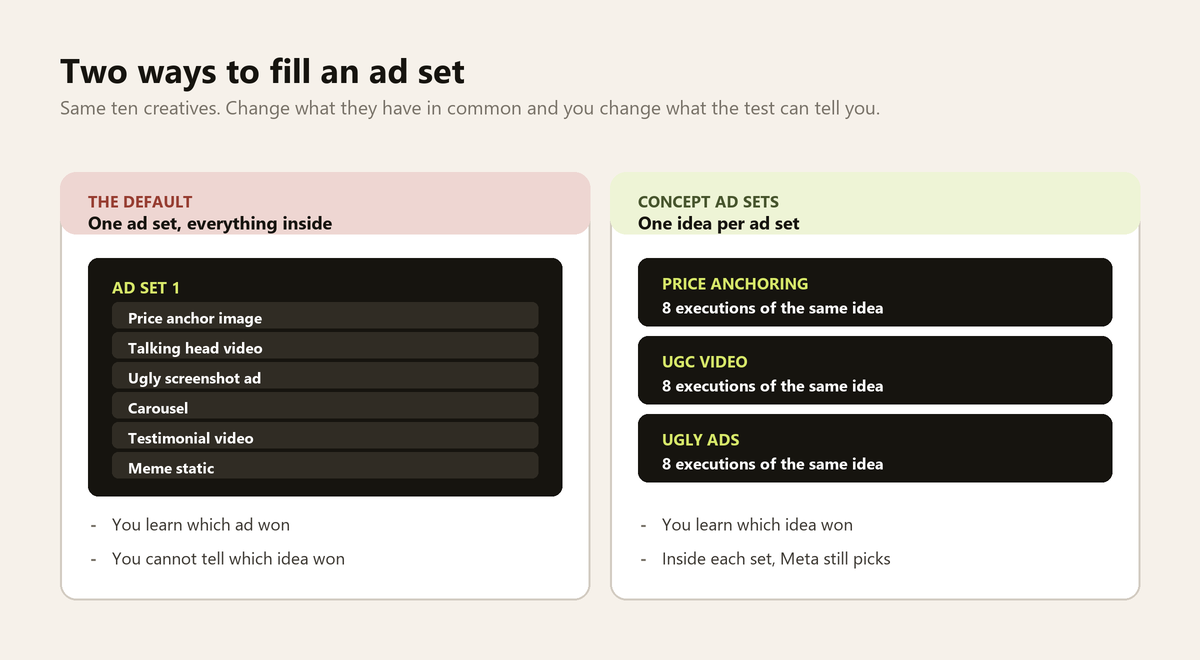
But it has a blind spot that took me a while to notice. It tells you which ad won. It does not tell you which idea won. And the idea is the only part of a winning ad you can actually repeat.
The method below changes one thing: what goes inside an ad set. Instead of ten unrelated creatives fighting each other, you put ten executions of the same idea in one ad set, and you give every idea its own ad set. I have been running it recently across several accounts and it has held up well.
One warning before you go further. The mechanics of this moved twice in the last two years, and most articles and videos about this method are describing an Ads Manager that no longer exists. That part is covered below too.
If you are earlier in the process and still putting the account together, the complete Meta ads guide walks through the whole sequence in order.
What Meta ads creative testing actually means
Meta ads creative testing is the practice of running different creatives under controlled conditions to find out which one produces the cheapest result. The word “controlled” is carrying that entire sentence.
Meta does not divide budget evenly between the ads inside an ad set. It decides early which ad looks promising and pushes spend into it. The moment you put several ads in one ad set, you have stopped running a controlled test and started running an auction with a house favourite.
That leaves you with two genuinely different questions, and they need two different structures:
- Which specific ad performed best? This is an ad-level question. Answering it honestly requires every ad to get the same budget.
- Which creative idea performed best? This is a concept-level question. Answering it requires every idea to get the same budget, but the ads inside each idea can fight it out.
Most advertisers are trying to answer the second question while running a structure that answers neither.
The structure most advertisers run, and what it hides
One campaign. One ad set. Every creative launched into it. Kill the bottom performers, keep the top ones, add more. This is the structure most creative testing advice still assumes you are running.
There is a lot to like about this. It concentrates conversions into a single ad set, which helps you clear the learning phase. It avoids the fragmentation that comes from splitting budget across a dozen tiny ad sets. It is the cheapest way to get a result today, and for a lot of accounts it is the right default. The reasoning behind consolidating like this is covered in the campaign structure that holds up when you scale.
Where it falls down is attribution. The ad that spent the most is not necessarily the ad that deserved to. It is the ad that made a good first impression on a small early sample, and then got fed. This is the whole argument for giving each ad its own ad set when you actually need a clean answer.
There is a second, quieter cost that almost nobody talks about. Say the winner turns out to be a talking head video. What did you learn? You learned that this video works. You did not learn whether talking head video as a format works, or whether the offer framing inside it was doing the work, or whether the same argument would have won as a plain static image.
Next month you make another video, and you are guessing again.
The concept ad set: one idea, many executions
Concept ad sets are creative testing at the level of the idea rather than the individual ad. A concept ad set holds several executions of a single creative idea. Not several creatives. Several attempts at the same argument.
Here are three concepts I have been running:
- Price anchoring. Every ad in the set leads with the expensive alternative before showing the price. Different images, different copy, same argument.
- UGC style video. Same offer, same rough script, different presenter and different footage. The variable inside the set is the person, not the pitch.
- Ugly ads. Deliberately unpolished. Screenshots, plain text, no design. They look wrong in a feed full of polished creative, which is the point.
Each concept gets its own ad set. Each ad set gets the same daily budget, the same audience, the same placements and the same optimisation event, and they all launch at the same time.
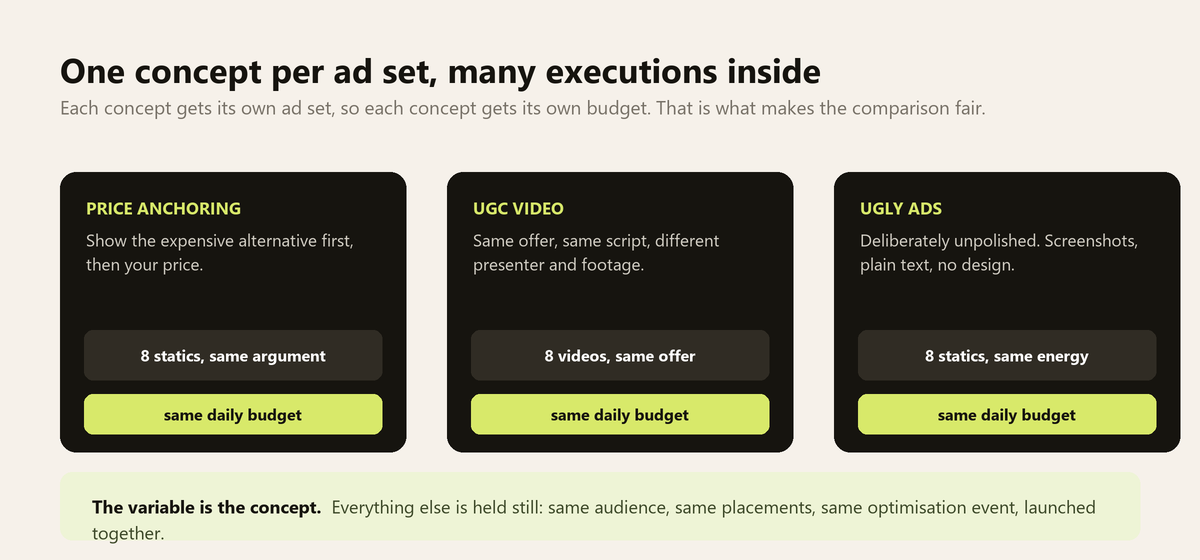
That last part is what makes the comparison mean anything. If price anchoring gets forty dollars a day and ugly ads get fifteen, you have not compared the ideas, you have compared the budgets. If you want help generating genuinely different arguments rather than cosmetic variations, the anatomy of ad copy that stops the scroll covers how angles differ from wording.
Why this does not contradict one ad per ad set
It looks like a contradiction. One article says give every ad its own ad set. This one says put ten ads in a single ad set. Both are right, and the reason why is the most useful thing in this article.
Budget is controlled at the ad set level. That one fact decides everything else.
Whatever you separate into different ad sets is the thing you can measure. Whatever you put inside a single ad set is the thing you have agreed to stop measuring.
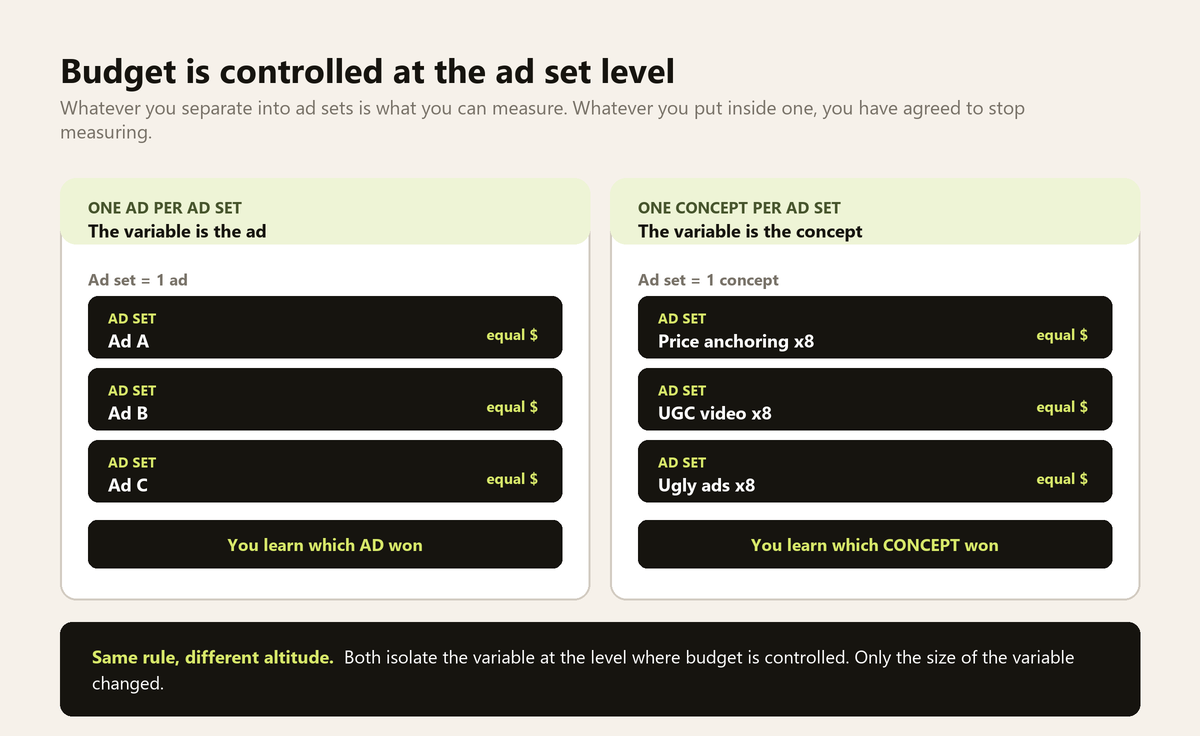
Run one ad per ad set and your variable is the ad, so you learn which ad won. Run one concept per ad set and your variable is the concept, so you learn which concept won. It is the same rule applied at a different altitude. The only thing that changed is the size of the variable.
Meta is blunt about this in its own documentation. Because these ads report aggregate performance across all their variants, Meta explicitly says it does not recommend using dynamic creative as a substitute for split testing. That is not a warning against the method. It is a warning against claiming the method answers a question it cannot answer.
So decide which answer you are buying before you build anything. If you need to know which specific ad won, one ad per ad set with equal budgets is still the only honest structure. If you need to know which idea is worth making more of, concept ad sets get you there for a fraction of the spend.
Where this lives in Ads Manager in 2026
This is where most content on this topic is now out of date, including videos recorded less than a year ago.
Two things changed:
- June 2024. Dynamic creative stopped being selectable when you create a new ad set under the Sales or App Promotion objectives. Campaigns built before that kept running, which is exactly why you still see the option in some accounts and in older tutorials.
- March 2026. The flexible ad format, which was Meta’s recommended replacement, was itself removed from ad setup.
The capability did not disappear, it moved. Multi-asset delivery now lives inside Advantage+ creative, through flexible media and the format display options, where the system still picks which of your uploaded assets to show to whom.
Here is the part worth holding onto: the concept ad set structure does not depend on any of those features. You can run it with ordinary ads, one asset each, several ads per concept ad set. That version takes longer to build and gives you cleaner reporting, because each ad reports separately. The automated formats simply make it cheaper to push a lot of assets through at once.
The structure is the strategy. The toggle is just plumbing, and Meta has now moved that plumbing twice.
How to see which asset actually delivered
The aggregate ad set number tells you the concept worked. It does not tell you which of your eight assets carried it. For that you have to open the breakdown.
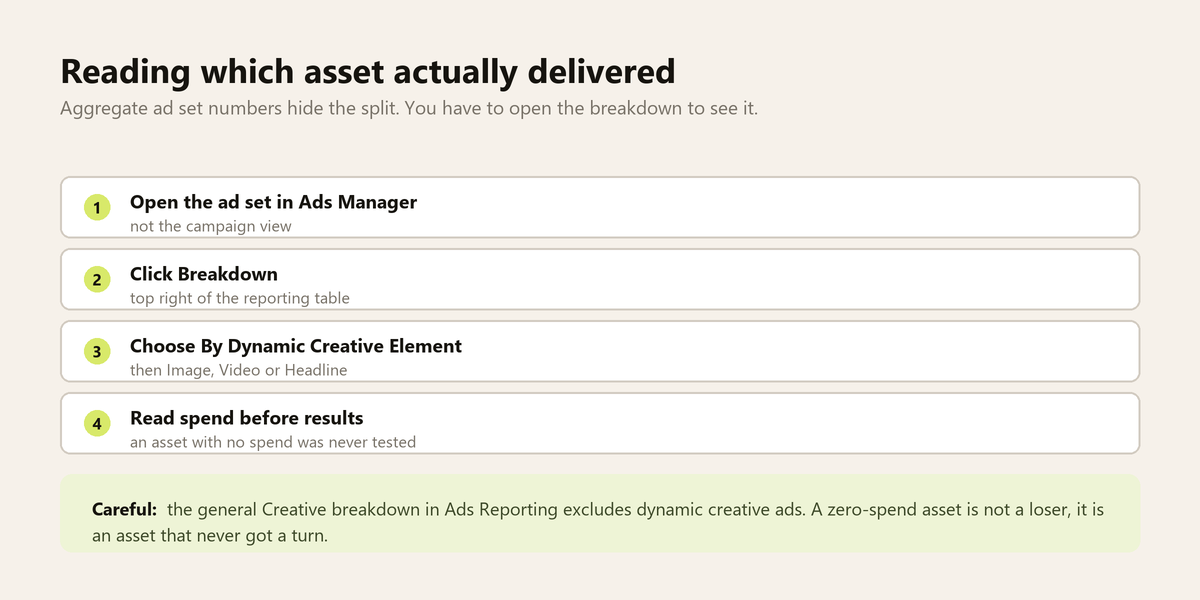
Two cautions that will save you from a wrong conclusion.
First, the general Creative breakdown inside Meta’s ads reporting explicitly excludes dynamic creative ads. If you use the wrong breakdown you will see nothing and assume something is broken.
Second, read spend before you read results. An asset with almost no spend is not a losing asset. It is an asset that never got a turn. Treating it as a loser is the exact mistake this whole article is about, just committed one level down.
What you gain and what you give up
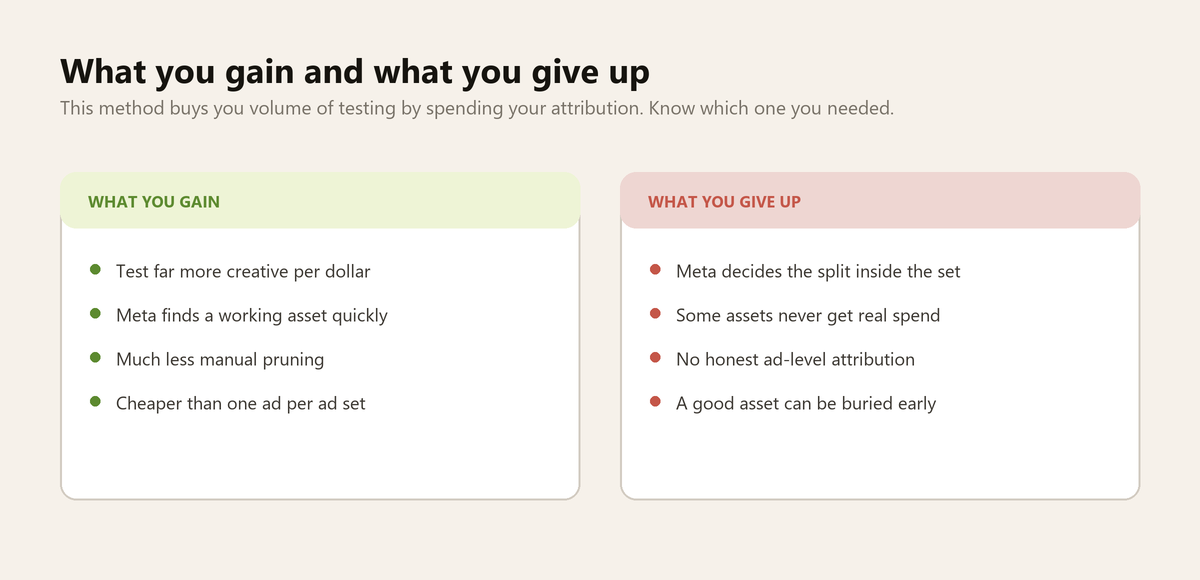
The trade is straightforward once you say it plainly. You are buying creative testing volume with attribution. You get to put far more creative in front of real people for the same money, and in exchange you accept that Meta, not you, decides how much of that money each asset gets.
That is a good trade when you have more creative than budget, which is most accounts. It is a bad trade when you are about to make an expensive decision, like committing a production budget to a format for the next quarter, on the basis of a result that was never a fair fight.
How to run Meta ads creative testing without fooling yourself
- Write down the question first. Concept or ad? If you cannot say which one you are asking, the structure will not save you. And none of this means anything if your tracking is dirty, so confirm your pixel is firing clean events before you spend on a test.
- Build one ad set per concept, not per creative. Three to four concepts is plenty. More than that and each ad set gets too little budget to leave the learning phase.
- Hold everything else still. Same daily budget, same audience, same placements, same optimisation event, same start time. If two things differ, the result cannot tell you which one caused it.
- Put five to ten executions of the same idea in each ad set. Be strict about this. If one of your price anchoring ads quietly becomes a testimonial ad, you have contaminated the set and the concept-level result is meaningless.
- Wait for the learning phase. Roughly fifty conversions per ad set per week is Meta’s own threshold. In practice most concept tests need three to seven days before the numbers mean anything.
- Judge at the concept level, then zoom in. Pick the winning concept. Then take its best few assets and re-test them one ad per ad set with equal budgets, so you find out which execution genuinely won. Now you can scale it without watching your ROAS collapse.
Step six is the whole point. These two methods are not rivals, they chain. Concept testing is the wide net. One ad per ad set is the precision instrument. Use the net first because it is cheaper, then use the instrument on whatever the net caught.
Questions people ask about Meta ads creative testing
How many ads should I put in one concept ad set?
Five to ten. Fewer than five and you are not really taking advantage of the structure, since you could have run those as separate ad sets and got cleaner data. More than ten and the spend per asset gets so thin that most of them never receive a meaningful test, which defeats the purpose of uploading them.
Is dynamic creative still available in 2026?
Not for new ad sets under the Sales or App Promotion objectives, which covers most direct response advertising. That changed in June 2024. Campaigns created before the change continue to run. The equivalent capability now sits inside Advantage+ creative, and the flexible ad format that briefly replaced dynamic creative was itself removed from ad setup in March 2026.
Does concept testing replace one ad per ad set?
No, and treating it as a replacement is the main way creative testing goes wrong. Concept testing tells you which idea deserves more investment. It cannot tell you which specific ad won, because Meta controlled the budget split inside each ad set. Use concept testing to narrow the field, then run a clean one ad per ad set test on the finalists.
How much budget does a concept test need?
Enough for every ad set to leave the learning phase independently, which means roughly fifty conversions per ad set per week. Work backwards from your cost per result. If your cost per purchase is twenty dollars, that is about a thousand dollars per ad set per week, and three concepts means three thousand. If that number is out of reach, run fewer concepts rather than underfunding all of them.
What counts as a different concept rather than a different ad?
A different concept changes the reason someone should care. A different ad changes how that reason is expressed. Swapping the background colour, the headline wording or the model is a different ad. Going from “here is why this is cheaper than the alternative” to “here is what happens if you keep doing nothing” is a different concept.
The takeaway
The default structure, one ad set with everything inside it, is not wrong. It is just answering a smaller question than most people think it is. It finds you a working ad. It does not find you a working idea.
Concept ad sets fix that by moving the variable up a level. You stop asking which of these ten creatives is best and start asking which of these three arguments is worth building on. Because each concept sits in its own ad set with its own budget, that comparison is actually fair, even though the comparison inside each ad set is not.
Good creative testing is not really about how many creatives you can launch. It is about deciding, before you launch anything, which question you want the numbers to answer. The rule underneath both methods is the same one. Budget is controlled at the ad set level, so whatever you separate into ad sets is what you get to measure. Choose that boundary on purpose and the numbers will answer the question you asked. Choose it by accident and they will answer a question you did not.
If you want the full sequence rather than one tactic, the guides library covers account setup, tracking, structure, creative and scaling in order. And if you would rather have someone look at your account directly, you can book a free twenty minute call and we will go through what your current structure is actually able to tell you.